


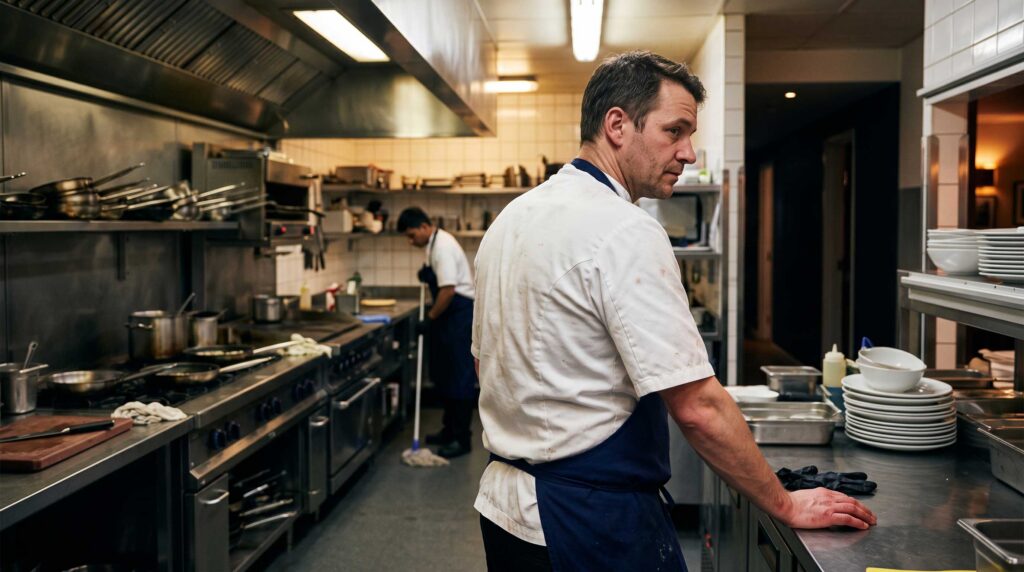
An experienced cook hands in their notice and the owner is taken by surprise – after all, “he seemed to like it here”. The reality is usually different: a departure rarely comes out of nowhere. It is the result of a long-term pattern that repeats across venues, cities and countries in hospitality. And the numbers behind it are truly high.
This article looks at how high turnover in kitchens really is, what is most often behind it according to the available data, and what operators can realistically do about it.
How high turnover in hospitality really is
Across industry sources the figures differ slightly depending on methodology, but they agree on one thing: hospitality has one of the highest turnover rates of any industry.
According to the US Bureau of Labor Statistics (BLS JOLTS data), average annual turnover across the whole food service industry has long hovered around 70–80% – in contrast to the usual cross-industry average of around 30–40%. The National Restaurant Association reported turnover of even over 120% for 2025. In quick-service restaurants (QSR), the turnover rate exceeds 130% – meaning the entire team is replaced more than once a year.
The difference between kitchen and front of house
Turnover does not look the same on both sides of the operation. According to some analyses, servers, hosts and bartenders (the front line of the operation) see turnover of around 80–90% a year – a combination of unpredictable shifts, fluctuating tips and the physical demands of service.
For kitchen staff (cooks, prep cooks, dishwashers), estimates differ more noticeably between sources – from roughly 43% in one analysis to 60–75% in another. This spread probably reflects different methodology and types of venues studied, but even the lower bound stays well above the usual cross-industry average.
Fine dining tends to do better
What is consistent across sources is the finding that fine dining has lower turnover than other segments – an estimated 50–60% a year, compared with 70–80% in casual dining. Better pay, a more stable schedule and the prestige of working in a respected venue appear to genuinely reduce turnover.
What is most often behind departures
Data from several independent sources agree on a similar pattern of causes – a combination of structural problems, not one isolated complaint.
Pay is the most commonly cited reason
According to one industry survey, almost half of hospitality employees (47%) cite low hourly pay as the main reason they plan to leave the industry. It is the single most frequently mentioned factor across the available sources.
Unpredictable shifts
A schedule announced only a few days ahead makes it impossible to plan childcare, transport or a second job. According to the cited studies, predictable shift scheduling can reduce absenteeism by a quarter and turnover by up to a fifth – which suggests how big a role an unstable schedule plays in departures.
Long shifts as the norm
In kitchen culture, shifts of 60 to 80 hours a week are common and not regarded as an exception. According to expert analyses, this is not an unavoidable consequence of the nature of the work, but rather a result of the industry long under-investing in adequate shift staffing and delegation systems that would allow more reasonable working hours.
Psychological strain and mental health
Here are numbers that should worry anyone who works in or runs the industry. According to research presented at the congress of the international chefs’ organisation Worldchefs (2024), 70% of cooks report having experienced work-related anxiety, and an estimated 40% of voluntary departures from the industry are directly linked to mental health problems. Another analysis reports that over 76% of hospitality workers have experienced some mental health problem during their careers, 63% of cooks report depression and 74% describe exhaustion from lack of sleep.
One source (the trade magazine Bar & Restaurant) also reports that over 17% of hospitality workers have been diagnosed with a substance use disorder – the highest share of all industries tracked. Even bearing in mind that this is a single cited source and the figure should be taken with caution, it is a strong signal of how demanding a working environment kitchens have long been.
Lack of career growth
According to a survey of hospitality job seekers, the opportunity for professional growth is among the three most important factors when looking for a new job. A kitchen without a clear path to advancement – from dishwasher to prep cook, from prep cook to cook, from cook to head chef – loses people who otherwise want to stay in the industry, just not in the same place forever.
What turnover really costs
High turnover is not just an inconvenience for the HR department – it is a direct financial cost that can be quantified.
According to one of the cited analyses, each employee departure costs on average roughly $5,900 (converted at the current exchange rate, roughly one hundred thousand Czech crowns) – counted including recruitment, training and lost productivity until the new hire reaches full speed.
On top of that come costs that never appear on any invoice:
- Inconsistent food quality, because new people keep learning the recipes and procedures from scratch.
- Higher waste and preparation errors during training.
- Overload on the remaining team, who cover for missing positions – which raises the risk of further departures and sets off a spiral.
- Manager burnout, as managers spend their time on constant recruiting instead of improving operations.
A restaurant losing around a hundred thousand crowns per departure, with dozens of departures a year, quickly reaches an amount that far exceeds what it would cost to pay better and keep people longer.
What operators can realistically do
The data show that the causes are structural, not personal failings of individual employees – and that is good news, because structural problems can be solved systematically.
Predictable shift scheduling. A schedule published with enough notice is among the measures with a documented effect on reducing both turnover and absenteeism.
A clear path for professional growth. Even an informal but communicated path of advancement gives people a reason to stay longer than they otherwise would.
Realistic shift staffing. A chronically understaffed kitchen leads to long hours for those who stay – and that is a direct route to the next departure. Investing in enough people often pays back in lower costs of constant recruiting.
Open communication about workload. Venues that actively address working conditions and offer support (some operators even introduce access to professional psychological help) report, according to the cited sources, lower turnover and more stable teams.
A competitive wage where possible. Pay remains the most frequently cited reason for leaving – and even a small but visible improvement in compensation can have a disproportionately large impact on whether a person stays.
Frequently asked questions
According to US industry data (BLS, National Restaurant Association), it is around 70–80% a year on average across the whole industry, and over 130% in quick service. That is significantly more than the cross-industry average, which is around 30–40%.
Yes. Front-of-house turnover (servers, hosts, bartenders) tends to be higher according to some sources, around 80–90% a year. For kitchen staff, estimates differ more between sources, from about 43% to 60–75%, but in both cases above the usual cross-industry average.
The most frequently cited reasons include low pay, unpredictable and long shifts (commonly 60–80 hours a week), psychological strain and burnout, and the lack of a clear path of professional growth.
According to research presented by Worldchefs (2024), roughly 40% of voluntary departures from the industry are directly linked to mental health problems. Over 70% of cooks, according to the cited data, report work-related anxiety.
According to the cited analysis, on average roughly $5,900 per departure, counted including recruitment, training and lost productivity. On top of that come hard-to-quantify costs such as inconsistent food quality and overload on the remaining team.
Sources
- Netchex – Restaurant Turnover Rate: Understanding Costs, Benchmarks, and Proven Retention Strategies. netchex.com
- Toast – What is the Average Restaurant Industry Turnover Rate for Employees? pos.toasttab.com
- Homebase – Restaurant Employee Turnover Rate: 2025 Statistics, Costs, and Retention Strategies. joinhomebase.com
- Forbes Advisor – Restaurant Employee Burnout: What It Is And How To Manage It. forbes.com
- NineGuides – Chef and Owner Burnout: Recognizing the Crisis and Building a Sustainable Career. nineguides.com
- International Culinary Studio – Burnout in the Kitchen Is Not Inevitable. It’s a Management Problem. internationalculinarystudio.com
Want the reservation side of your operation to add no unnecessary stress to the kitchen or the dining room?
Rezervato automates reminders, confirmations and the occupancy overview, so your team deals with guests, not admin.
Try Rezervato for free