


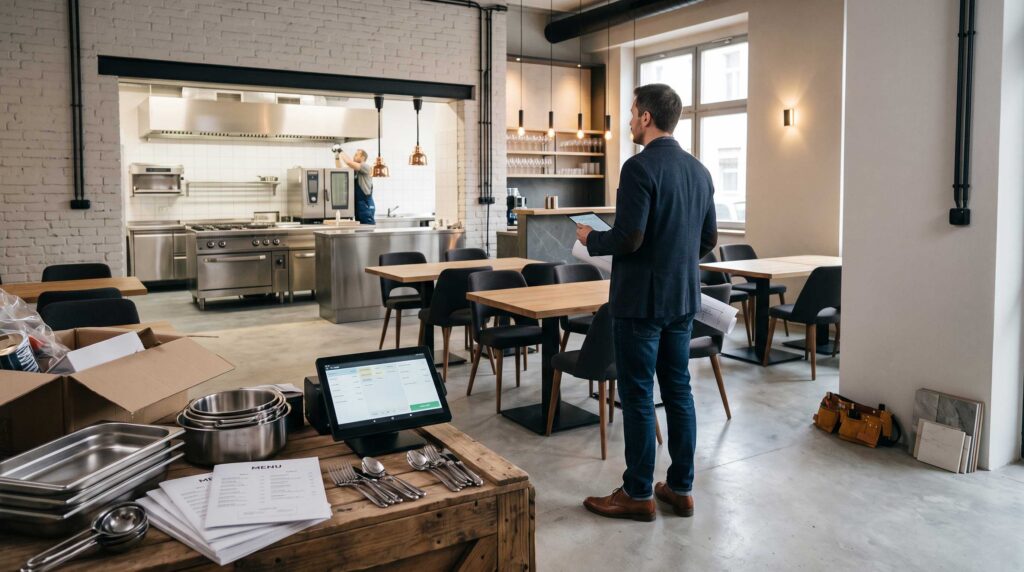
“How much will it actually cost?” is the first question anyone considering their own restaurant asks – and also the one most people badly underestimate at the start. It is not just kitchen equipment and a few tables. It is made up of a dozen items, some of which newcomers do not connect with opening a business at all until they land on the desk as an invoice.
This article breaks down where the money really goes when you start a restaurant – by cost category, not by one cherry-picked figure that would not fit two different venues anyway.
Why there is no single number
Before we get into the breakdown, let us be clear: there is no single valid answer to the question “how much does it cost to open a restaurant”. According to industry sources from the US market, the range runs from tens of thousands of dollars for a small fast-casual concept in a space that was previously also a restaurant, to over two million dollars for a large restaurant built from scratch in a big city.
The commonly used median for an independent restaurant in US sources is around $275,000 to $425,000 for a full-service operation, and significantly lower for faster concepts (fast casual). These figures come from the US market and, converted to Czech prices for property, construction and wages, they will be lower – but the structure, that is, the ratio between the individual cost categories, carries over to Czech and Slovak conditions.
A more useful metric: cost per seat
When absolute figures do not fit your market, converting to a unit of capacity helps. Industry data suggest roughly $3,000+ per seat for a leased space with standard operation – significantly more for fine dining ($5,000–8,000 per seat), less for quick service ($1,500–3,000 per seat). Even if you convert the absolute figures differently, the ratio between concept types stays the same: the more demanding the service and equipment, the higher the cost per seat.
Cost breakdown by category
Here is the main value of this article – not one number, but a map of where the money actually goes, and the approximate share of each category in the total budget.
Build-out and fit-out of the space
The single largest item. According to industry analyses, build-out and space alterations typically make up 25–35% of the total budget, in some cases (demanding conversion, the need to deal with ventilation, drains, utilities) significantly more. A space that was previously a restaurant and already has an extraction hood, grease trap and utilities saves a substantial amount compared with building from the floor up.
Kitchen equipment and technology
Commercial ranges, refrigeration, dishwashers, extraction hoods and prep equipment – kitchen equipment is among the most expensive one-off investments. For smaller concepts, costs can be reduced by buying refurbished equipment or equipment from closing-down venues; for more complex concepts (fine dining, high production volume), the share of the budget grows instead.
Rent, deposit and prepaid fees
Before a restaurant earns its first revenue, you usually need to pay a deposit (commonly several months of rent upfront), the first months of rent and possibly lease brokerage fees. This item tends to be underestimated because it does not show up as “equipment”, yet it is cash you must have available right at the start.
POS and technology
A point-of-sale system is no longer just a cash register – it is the hub through which orders, payments, inventory and reporting flow. Hardware (terminals, printers, card readers) is a one-off cost, while monthly software is ongoing. You also need to factor in a reservation system, unless you plan to get one free as part of a POS package.
Licences, permits and insurance
A food-service venue requires a set of permits and licences – hygiene approval, an alcohol licence (if relevant), building permits for alterations and appropriate insurance. This category is usually smaller in absolute terms than construction or equipment, but it is a prerequisite for opening and it is easy to underestimate in planning.
Staff before opening
A restaurant needs its team ready before it opens the doors – cooks, servers, a host, a manager. Training, trial services and so-called “mock service” (a rehearsal of full operation without guests or with invited guests) typically take several weeks before the real launch, and these are payroll costs that arise before the first revenue arrives.
Initial stock of ingredients and supplies
The kitchen needs to be stocked with ingredients, packaging, napkins and other supplies from day one. For concepts with a wider menu or premium ingredients, this item is higher.
Launch marketing
Opening without marketing means relying on random passers-by. The launch budget (digital and local promotion, opening events, photos for profiles) is a smaller category in absolute numbers, but it directly affects how quickly the restaurant reaches its planned occupancy.
Working capital
This is the category new operators underestimate most often – and it is one of the most frequently cited reasons restaurants fail in the first months. Industry recommendations agree on a reserve of 3 to 6 months of total operating costs, kept separate from the equipment and construction budget. In the first months after opening, a restaurant usually does not reach planned revenue, while wages, rent and suppliers must be paid from day one.
How much of the budget goes where
For quick orientation – approximate shares of the main categories in the total startup budget according to industry sources:
| Category | Approximate share of budget |
|---|---|
| Build-out and fit-out | 25–35% (more for demanding conversions) |
| Kitchen equipment and technology | a significant part, varies by concept |
| Rent, deposit, prepaid fees | a few percent, but cash needed right at the start |
| POS and technology | smaller one-off item + ongoing costs |
| Licences, permits, insurance | smaller, but a necessary item |
| Staff before opening | from a few thousand up to the low tens of thousands of dollars (US data) |
| Initial stock | smaller, continuously replenished item |
| Launch marketing | smaller one-off item |
| Working capital (reserve) | separate, 3–6 months of operating costs |
Shares differ by concept and market, but the order of importance stays consistent across sources: construction and equipment dominate one-off expenses, while working capital is a separate and equally important category that cannot be mistaken for the equipment budget.
Where there is real room to save
Industry sources agree on several measures that can cut the startup budget significantly without compromising quality:
- A space that was already a restaurant. An existing extraction hood, grease trap and gas and drainage connections cost a fraction of building from the floor up.
- Refurbished or used equipment. Closing venues, auctions and specialised dealers offer commercial equipment at significantly lower prices – provided you inspect it thoroughly before buying.
- Phased menu equipment. You do not need complete equipment from day one for every menu item you plan to add in a year. A smaller, operationally proven menu at launch lowers the initial equipment investment.
- Your own labour on non-trade tasks. Painting, assembling furniture and decorating do not require a licensed tradesperson – save qualified (and more expensive) labour for plumbing, electrical and gas work, where the saving is not worth the risk.
The most common underestimates that cost more later
Working capital separate from the investment budget. The most common mistake is to count only equipment and construction costs and not include a separate reserve for the first months of operation, when revenue has not yet reached the planned level.
A contingency reserve on top of the estimate. Industry recommendations agree on increasing the total budget by 10 to 20 percent as a reserve for unexpected expenses – the first budget almost never fits exactly.
The time between hiring and opening. Staff wages start running from the moment of hiring, revenue only from opening. This gap tends to be longer than new operators expect, and it needs to go into working capital, not the equipment budget.
The time between opening and ramp-up. According to employment data, it typically takes sixty to ninety days for staffing and operations to fully stabilise at the planned level – during that whole time wage costs are at full level while revenue is still growing.
Frequently asked questions
According to US industry data, costs range from tens of thousands of dollars for a small concept in a ready-made space to over two million dollars for a large restaurant built from scratch. The median for an independent full-service restaurant is reported at around $275,000 to $425,000. For the Czech and Slovak market, absolute figures are lower, but the cost structure is similar.
Build-out and fit-out of the space typically makes up 25–35% of the total budget according to industry sources, and more for demanding conversions.
Industry recommendations agree on 3 to 6 months of total operating costs, kept separate from the equipment and construction budget. This reserve covers the period until the restaurant reaches planned revenue.
The most effective approach is to choose a space that previously served as a restaurant (existing hood, grease trap, utilities), buy refurbished equipment and launch with a smaller, operationally proven menu that can be expanded gradually.
What is most often missing is a separate working-capital reserve, a contingency reserve for unexpected expenses (10–20% extra) and the wage costs for the period between hiring staff and full stabilisation of operations, which typically lasts 60–90 days after opening.
Sources
- CKitchen – How Much Does It Cost to Open a Restaurant in 2026? Full Cost Breakdown. ckitchen.com
- Superior Seating – How to Open a Restaurant in 2026: Costs, Steps & Full Startup Guide. superiorseating.com
- RestOps – Restaurant Startup Costs Breakdown (2026). restops.co
- VantaInsights – How Much to Open a Restaurant? Startup Costs (2026). vantainsights.com
- Restaurant Velocity – How Much Does It Cost to Open a Restaurant in 2026? Complete Breakdown. restaurantvelocity.com
Rezervato has a free plan with your first 100 reservations a month – ideal for launching a new restaurant.
Want an overview of occupancy and reservations from day one, without having to budget for another expensive system?